
Life and Healing isn’t linear — and that’s okay.
If you’ve ever found yourself thinking, “Why am I back here again?”—back in a familiar emotional place, revisiting an old trigger, or grappling with a pattern you thought you had already worked through—you are not failing at healing. This article is for neurodivergent adults and anyone interested in trauma recovery who wants to understand why healing doesn’t always look the way we expect.
Introduction
This blog post explores why healing isn’t linear, especially for neurodivergent adults, and why this matters for anyone on a trauma recovery journey. The belief that healing should be a linear process can cause unnecessary pain and frustration for individuals. Many people expect healing to be a straight line—one step after another, always moving forward. In reality, healing is a messy, spiraling journey with good days, bad days, setbacks, and breakthroughs.
For neurodivergent adults, this experience is deeply confusing and often layered with shame. You do the therapy. You build awareness. You learn new tools. And then, seemingly out of nowhere, something familiar resurfaces: the anxiety, the shutdown, the grief, the relational rupture, the exhaustion.
Linear healing is the belief that healing is a straight line and doesn’t follow a step-by-step process. But the path of healing is unpredictable due to the complex way the human mind and body process trauma, especially for those with neurodivergence or trauma histories.
Viewing healing as a spiral means revisiting the same themes from a higher level of self-awareness and strength. Understanding this truth can significantly change how you relate to your growth, setbacks, and sense of self. Facing the reality of your experiences is an essential part of the healing journey. Recognizing the non-linear nature of healing helps reduce shame and self-judgment during setbacks.
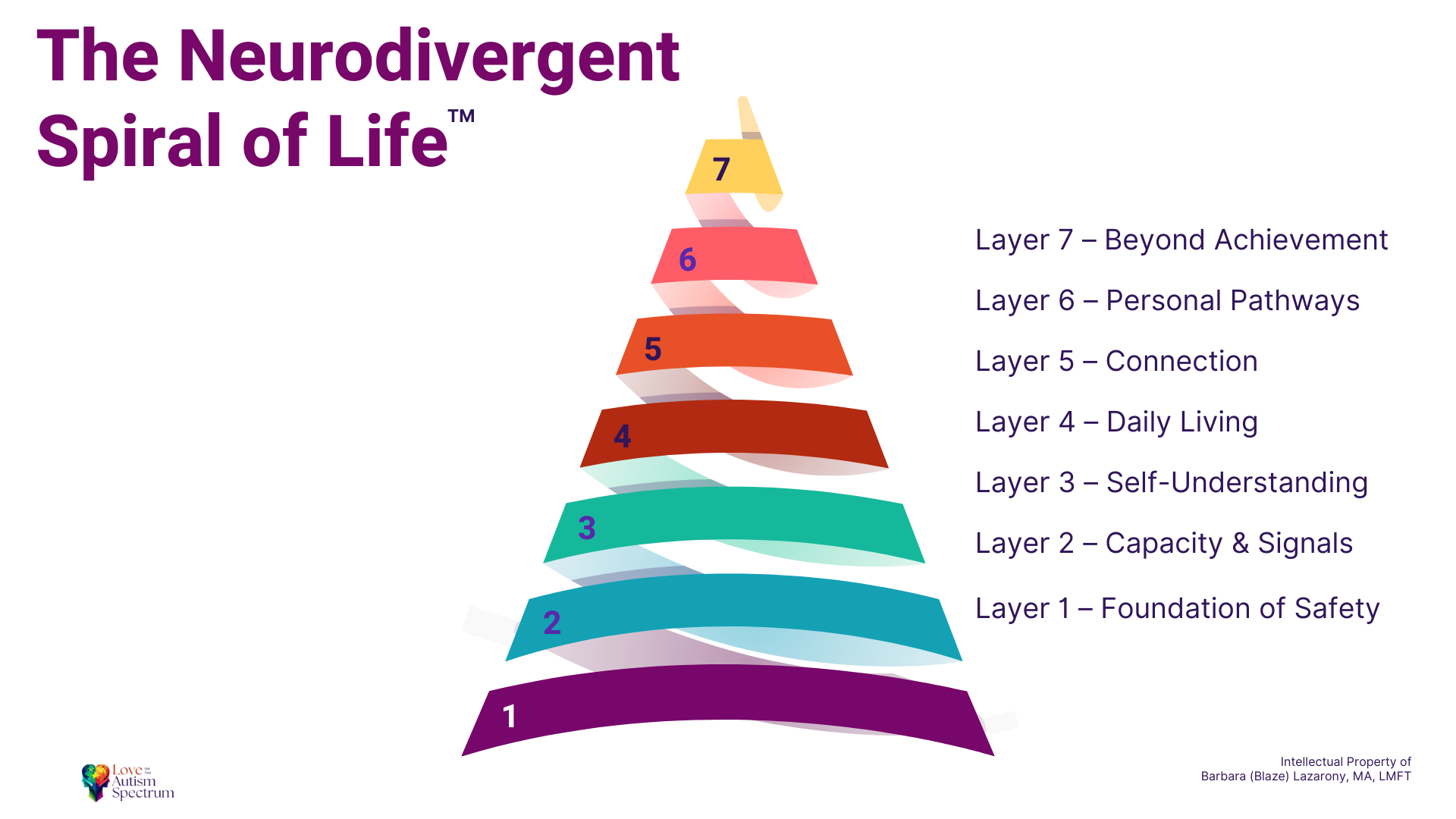
In this blog post, we’ll explore why linear models of healing often harm neurodivergent people, how the Neurodivergent Spiral of Life™ developed by Barbara (Blaze) Lazarony, LMFT, offers a more accurate and compassionate framework, and how to recognize real progress even when you feel like you’re revisiting old ground. Remember, healing takes time—be patient and gentle with yourself as you move through your journey.
3 Key Takeaways
- Healing is not regression just because something reappears. For neurodivergent people, revisiting themes is often a sign of deeper integration, not failure.
- Linear healing models don’t fit neurodivergent nervous systems. They ignore sensory, emotional, relational, and cognitive variability.
- The Neurodivergent Spiral of Life honors capacity, not speed. Growth is measured by increased choice, safety, and self-understanding—not by how quickly something disappears.
The Problem With Linear Models of Life and Healing
Most cultural narratives about healing are deceptively simple. Society often promotes the idea that healing should follow a clear, predictable path.
You identify the problem. You process it. You move on.
This model is deeply embedded in self-help culture, productivity spaces, and even many therapeutic frameworks. It assumes that once something has been “worked through,” it should no longer return. If it does, the implication is that something went wrong.
For neurodivergent adults—particularly autistic people, ADHDers, and those with complex trauma—this assumption creates a quiet but persistent sense of failure.
Because your nervous system doesn’t work that way.
Neurodivergent healing is shaped by:
- sensory processing differences
- fluctuating access to regulation
- cumulative stress and masking history
- relational trauma and misunderstanding
- nervous system overload cycles
Cultural and societal expectations can add pressure to appear strong and resilient throughout the healing process, making it even harder to honor your own pace.
Linear models don’t account for these realities. They treat healing as an intellectual achievement rather than a whole-body, whole-life integration process.
When you apply a linear model to a non-linear nervous system, the result is often self-blame. Society often pressures individuals to heal on a strict timeline, leading to unrealistic expectations about recovery.
To better understand how healing actually unfolds, let’s explore what mental health really means for neurodivergent individuals.
Understanding Mental Health
Mental Health as a Process
Understanding mental health requires grounded truth, not solutions. Mental health isn’t a destination you arrive at—it’s a living process that moves with your nervous system’s natural rhythms. Like all embodied wisdom, mental health doesn’t follow straight lines. There will be regulation and dysregulation, moments when you feel seen and times when you feel lost. This is exactly what’s needed—no more, no less.
Your mental health emerges from multiple influences: genetics, environment, lived experience, and your nervous system’s unique responses to the world. For those navigating trauma or neurodivergent identity, healing often feels cyclical—you revisit familiar emotional territory, but each time with deeper self-trust and resilience. This isn’t failure. This is how transformation actually works.
Building Regulation Tools
Building regulation tools becomes essential for navigating life’s inevitable stress and emotional intensity. This might look like offering yourself compassion when dysregulated, connecting with support when emotions need processing, or allowing rest without shame. Support isn’t weakness—it’s how you build genuine resilience and move forward at the pace of your nervous system.
Your nervous system holds the truth of how you experience and recover from overwhelm and trauma. Understanding your system—what activates it, what soothes it, what it genuinely needs—helps you develop strategies that actually work for your unique wiring. Self-care isn’t performative wellness; it’s nervous system regulation. Whether through stillness, gentle movement, creative expression, or time in nature, these practices help you return to what feels true.
Setbacks and difficult days are part of the lived experience. Healing happens in nervous system time, and it’s essential to meet yourself with the same patience you’d offer a trusted friend when life feels hard. Every step you take, however small, matters. By understanding mental health as a dynamic, breathing process, you can offer yourself the compassion and safety you would give someone you love—honoring that every experience is meaningful on your path toward embodied well-being.
You’re not alone in this truth. Support, understanding, and genuine regulation practices are always available. Every day you choose to honor your mental health, you’re moving forward—at your own pace, in your own way, exactly as your system needs.
Next, let’s look at why healing for neurodivergent people often feels repetitive and what that really means.
Why Neurodivergent Life and Healing Many Times Looks Repetitive
The Nature of Repetition in Healing
Many neurodivergent people report that healing feels repetitive.
The same conversations resurface. The same relational dynamics get activated. The same emotional themes return at different stages of life.
This repetition is often misinterpreted as being “stuck,” or as a sign of ongoing struggle.
But repetition is not stagnation.
It’s layered integration.
Each time something resurfaces, it’s often because your system has reached a new level of capacity—enough safety, language, or support to process it differently than before.
You are not revisiting the same place.
You are revisiting the same theme from a different altitude.
It’s important to recognize that each person’s healing needs are unique, and revisiting themes is a normal part of addressing those needs.
Revisiting Themes as Progress
Devon Price, in their book entitled Unmasking Autism, directly addresses masking, identity grief, and post-diagnostic reorientation, especially for late-identified autistic adults.
The healing process can feel like a roller coaster with ups and downs.
Now, let’s introduce a model that better reflects this reality.
Introducing the Neurodivergent Spiral of Life™
The Neurodivergent Spiral of Life™ offers a framework that reflects how neurodivergent nervous systems actually heal and grow.
Instead of asking, “How far have I moved away from this issue?” The Spiral asks, “How has my relationship to this issue changed?”
In the Spiral model:
- Growth happens through cycles, not straight lines
- Familiar challenges reappear, but with new awareness
- Capacity and ability expand over time, even when discomfort returns. The nervous system takes time to learn new patterns during the healing process, and individuals have the ability to develop new skills and capacity for healing as they move through each cycle.
- Healing is measured by choice, not elimination
- Healing is an ongoing practice—it requires patience, repetition, and self-compassion
You may still experience anxiety—but you recognize it sooner. You may still need recovery—but you advocate for it earlier. You may still grieve—but with less self-attack and more self-trust.
That is Spiral healing.
Let’s address a common misconception about what it means to revisit old ground.
Why “Back Here Again” Is a Misleading Thought
One of the most painful internal narratives neurodivergent adults carry is about overwhelming feelings:
“I thought I’d already dealt with this.”
This thought assumes that healing means never encountering the same emotional territory twice.
But human development—especially neurodivergent development—doesn’t work that way.
Life changes bring new layers:
- relationships deepen or end
- careers shift
- diagnoses are discovered later in life
- masking drops as safety increases
Each transition recontextualizes old experiences. In these moments, you may realize that certain patterns or coping strategies are recurring, and that recognizing them is a key part of growth. Developing the ability to cope with these recurring patterns is essential, as healthy coping skills help you navigate setbacks and stress as part of the ongoing healing process.
Of course old material reappears. You’re not the same person you were last time.
Acknowledging setbacks without judgment is an important step in the healing process.
Let’s see how the spiral model can help reduce shame and self-judgment.
How the Spiral Protects Against Shame
Linear models create an implicit hierarchy:
- forward = good
- backward = bad
The Spiral dissolves this binary.
There is no backward on a spiral.
There is only return with difference.
This matters deeply for neurodivergent adults who already carry histories of being told they are “too slow,” “too sensitive,” or “not progressing fast enough.” Learn more about emotional masking and its impact on mental health.
The Spiral reframes healing as relationship-building with yourself, not performance. Practicing self compassion is essential during the healing process, allowing you to meet setbacks and challenges with kindness and understanding rather than judgment. Meeting these challenges in a healthy way supports resilience and helps you return to healthy habits, reinforcing ongoing healing.
Next, let’s clarify what real progress looks like in spiral healing.
What Progress Actually Looks Like in View Your Life as a Spiral
Progress in the Neurodivergent Spiral of Life™ may include:
- noticing your nervous system cues earlier
- needing less explanation to justify your needs
- recovering more quickly after overload
- choosing different boundaries the second or third time
- feeling less urgency to “fix” yourself
These shifts are often subtle—but profound. By shifting your focus to these positive changes, you can gain clarity and support your emotional regulation throughout the healing process.
They don’t make good before-and-after photos. They don’t disappear symptoms overnight.
But they change your quality of life.
Tracking small victories along the way can help maintain motivation during difficult times in your healing journey.
Let’s look at a real-life example of spiral healing in action.
A Story From the Therapy Room About Why Neurodivergence Isn’t Linear
One client, whom I’ll call Emily, came to therapy frustrated and discouraged. She had spent years working on emotional regulation and communication skills. Yet during a particularly stressful season at work, she found herself dealing with emotional struggles like shutting down again—canceling plans, losing words, feeling overwhelmed by small decisions, and experiencing depression.
“I thought I was past this,” she said. “I feel like I’m back at square one.”
But when we slowed down and looked more closely, something important emerged.
Emily noticed her shutdown sooner than ever before. She asked for time off instead of pushing through. She communicated her limits without apologizing.
Her system still needed rest—but she met that need with less self-violence. Maya also began to recognize that she deserves support and understanding as part of her healing journey.
That wasn’t regression.
That was Spiral growth.
Talking to someone you trust, like a neurodivergent therapist and coach, can significantly impact the healing process.
Let’s explore why cycles are so important for neurodivergent nervous systems.
Why Neurodivergent Nervous Systems Need Cycles
Neurodivergent nervous systems often process information and emotion in waves, much like a never-ending pendulum.
Sensory input accumulates. Emotional meaning unfolds over time. Insight lands first cognitively, then somatically.
Linear frameworks privilege insight alone.
The Spiral honors embodiment.
It recognizes that understanding something intellectually doesn’t mean your body is finished integrating it.
And that’s not a flaw.
That’s biology.
Each setback offers a chance to learn and adapt, contributing to personal strength and resilience.
Next, let’s discuss how self-care supports spiral healing.
The Importance of Self-Care in Spiral Living and Healing
Self-Care as Nervous System Medicine
Self-care isn’t a wellness trend—it’s nervous system medicine for those of us walking the spiral path of healing. When your body holds old wounds and your system cycles through activation and rest, self-care becomes exactly what’s needed to support your regulation and resilience.
This isn’t about bubble baths or escaping your truth. It’s about honoring what your nervous system requires so you can move through emotional waves without drowning in them.
Listening to Your Body’s Wisdom
What self-care looks like lives in your body’s wisdom, not someone else’s prescription. Maybe your system needs the stillness of meditation to find safety in the present moment. Maybe it craves gentle movement that honors where you are today, or time in nature that reminds you of your inherent belonging.
Perhaps it’s simply permission to rest without the guilt that says productivity equals worth. These aren’t lifestyle choices—they’re acts of nervous system tending that help you process what needs processing at the pace your body can handle.
Self-care isn’t a band-aid for broken parts of you, and needing it often doesn’t mean you’re doing healing wrong. It’s how you resource yourself for the long game of becoming whole. When you tend to your nervous system with this kind of intentional care, you’re not just surviving the spiral—you’re moving through it with the compassion and steadiness that true healing requires. Every moment you choose to honor your body’s needs is you choosing yourself, again and again.
Now, let’s talk about letting go of deadlines in your healing journey.
Letting Go of the Deadline for Healing
One of the most harmful side effects of linear healing models is the invisible deadline they impose.
- You should be over this by now.
- You’ve had enough therapy.
- Other people moved on faster.
The Spiral removes the deadline.
Healing unfolds in relationship with safety, support, and life context—not on a schedule. Moving forward in your healing journey is about gradual progress, resilience through setbacks, and honoring your unique pace rather than meeting arbitrary timelines.
This is especially important for neurodivergent adults whose lives may include ongoing stressors, accessibility barriers, or late diagnoses that reopen old narratives.
Unmasking grief often surfaces quietly, without a clear container to hold it. If you’re navigating this loss and trying to understand who you are becoming, support can help clarify the process without rushing it. Book a FREE “Clarity and Connection” Zoom Session, and we can talk about next steps together.
Creating a progress timeline can serve as a motivator by visualizing significant milestones in your healing journey.
Let’s see how to reframe setbacks through the spiral lens.
Reframing “Setbacks” Through the Spiral Lens
What we often call setbacks are actually signals.
They point to:
- increased capacity that allows deeper material to surface
- new environments revealing unmet needs
- transitions that require renegotiation of boundaries
- emotional pain or distress that can arise as part of the healing process
The Spiral doesn’t ask you to push through these moments.
It asks you to listen.
Reframing setbacks as opportunities to learn from pain and challenges can provide valuable learning experiences and promote personal growth.
Next, let’s see why the spiral framework is so regulating for neurodivergent people.
Why This Framework Is Regulating
For many neurodivergent people, the Spiral is not just conceptually helpful—it’s physiologically regulating.
It reduces:
- urgency
- self-criticism
- fear of “doing healing wrong”
- the distress of emotional fluctuations when you feel worse before you feel better
It replaces them with:
- curiosity
- compassion
- permission to move at your own pace
And when the nervous system feels safer, integration happens more naturally.
Healing isn’t linear—progress often involves cycles of feeling worse and better. Healing requires time and intentional work, such as therapy or active self-care.
Let’s look at the role of community in spiral healing.
The Role of Community in Spiral Healing
Healing happens in a relationship, not in isolation. Community support becomes your steady companion on this winding path—offering genuine connection, deep understanding, and quiet encouragement exactly when your nervous system needs it most.
Support groups, whether you meet in person or gather online, create sacred space to share what’s true for you, to feel your emotions without judgment, and to learn from others who carry similar stories. These spaces offer understanding and empathy through shared experiences, fostering validation and awareness for everyone involved. They remind you that healing’s natural rhythm includes both expansion and contraction, and that difficult seasons are not evidence of your failure—they’re part of how growth actually works.
Therapists and counselors can hold space alongside you, helping you discover coping strategies that honor your unique nervous system and walking with you through challenging emotions at the pace that feels right. Being held by supportive community—whether through professional guidance, group connection, or trusted friends—helps you stay anchored to your healing path, especially during weeks when progress feels invisible or when life feels particularly heavy.
Community support gives you permission to move at your own organic pace, without pressure to match anyone else’s timeline or compare your inner world to another’s journey. It offers the validation your system craves and the understanding that makes setbacks feel less overwhelming and small victories feel worth celebrating. When you surround yourself with people who truly see your worth, you remember this essential truth: healing doesn’t follow straight lines, and that’s not only okay—it’s exactly how it’s meant to be. Together, you can navigate each spiral with greater trust, embracing every phase as meaningful movement toward deeper resilience and emotional wholeness.
Let’s finish with some practical ways to apply the spiral model to your own life.
Applying the Spiral to Your Own Life
You might begin by gently asking:
- What feels familiar right now?
- How am I meeting it differently than before?
- What support do I have now that I didn’t then?
- Am I having a bad day? If so, can I remind myself that a bad day is a normal part of the healing process and not a sign of failure?
You don’t need to force answers.
Awareness itself is Spiral movement.
Engaging in lifestyle medicine, such as healthy eating and regular exercise, can also improve your overall well-being as you move through the nonlinear process of healing.
Summary
Healing isn’t a straight line you fail to follow.
It’s a spiral you learn to travel with more skill, support, and self-trust over time.
Both a bad phase and a good phase are natural parts of the healing journey, and moving between them is expected as you grow.
Returning to familiar places doesn’t mean you’re stuck. It means your system is ready for the next layer.
You are not behind. You are integrating.
And when healing unfolds in a spiral, progress doesn’t erase the past—it transforms your relationship to it.
Healing is a process that requires time and patience.
A Special Note:
Layer 1 of the Neurodivergent Spiral of Life™ focuses on safety, identity, and self-believability. To support this foundational layer, I offer three gentle, nervous-system-aware tools: Pain Awareness Zones™, The Sensory Ladder Tracker & Ritual Builder™, and When I First Felt Different™. Click here to sign up and receive these FREE Layer 1 resources.
Together, these tools help you notice what your body, emotions, and history have been communicating—without needing to analyze, justify, or relive the past. They’re designed to help you recognize early signals of overwhelm, understand how you learned to adapt, and begin building trust with your own experience. You can use them slowly, non-linearly, and in whatever order feels safest—because healing doesn’t begin with fixing, it begins with being believed.
Frequently Asked Questions
What does it mean that healing is a spiral?
It means growth happens through cycles of revisiting themes with increasing awareness, capacity, and choice—rather than permanently eliminating experiences.
Why do neurodivergent people revisit the same struggles?
Because neurodivergent nervous systems integrate experiences in layers, especially as safety, language, and self-understanding increase. This is a common aspect of mental health, where healing isn’t linear and progress often involves revisiting challenges as part of the broader healing process.
Is revisiting old patterns a sign of failure?
No. It’s often a sign that you’re meeting familiar material with more resources and less self-abandonment than before. Emotional challenges like self hate can arise during this process, but therapy and support can help manage these feelings and support continued growth.
How can I tell if I’m making progress in spiral healing?
Look for reduced self-blame, earlier awareness, faster recovery, clearer boundaries, and increased self-trust—even if challenges still appear.